

I think of a grant strategy as a tool of creative liberation — from the cycle of reactive, haphazard applications fueled by anxiety or uncertainty; from the feelings of defeat that come with a cascading series of impersonal email rejections; from starting your grant fundraising plan from scratch each year, or with each project, or worse — not having one at all. A grant strategy is a way out of the riptides of random applications, and into a sense of intentionality and control over the outcomes.
I tell all of the artists I work with: grants are often not enough to sustain a practice. Even a well designed strategy is dependent on too many external factors (jurors, shifting funding priorities, and the subjective nature of art) to be reliable. However, if applications are systematized, and you maintain a way of approaching them that combines practical (“match”) and aspirational (“reach”) programs in the correct balance, then you may be able to count grants among your several income streams as an artist.
I’m here to help you get there. This article breaks down the U.S. arts funding ecosystem, so that you can build that knowledge into a repeatable grant strategy that can actually generate income. Let’s start by talking about the components of a good grant strategy, and then get you the information you need to build your own.
What is a grant strategy, and how do I build one?
A grant strategy is a living document, not a one-time list. You’re building something to return to and update as your practice develops: adding new programs, removing ones that have closed or that you’ve outgrown, tracking deadlines and results.
A grant strategy operates on a 6-9 month horizon minimum. Most grants (with a few exceptions) are not short-term funding mechanisms. The application you submit today is funding work that’s three, six, and sometimes twelve months out. Build accordingly.
A resilient grant strategy balances career-aligned (“match”) programs — ones you're well-positioned to win right now — with aspirational (“reach”) programs you’re actively building toward. The small wins compound. Collecting them early makes you more competitive for larger opportunities down the line.
Your strategy should be shaped like a pyramid, with a strong foundation in local and regional programs, building towards national and international funders. The following Funder Pyramid outlines the seven core funder types you need to know, organized from most accessible at the base to most aspirational at the top.
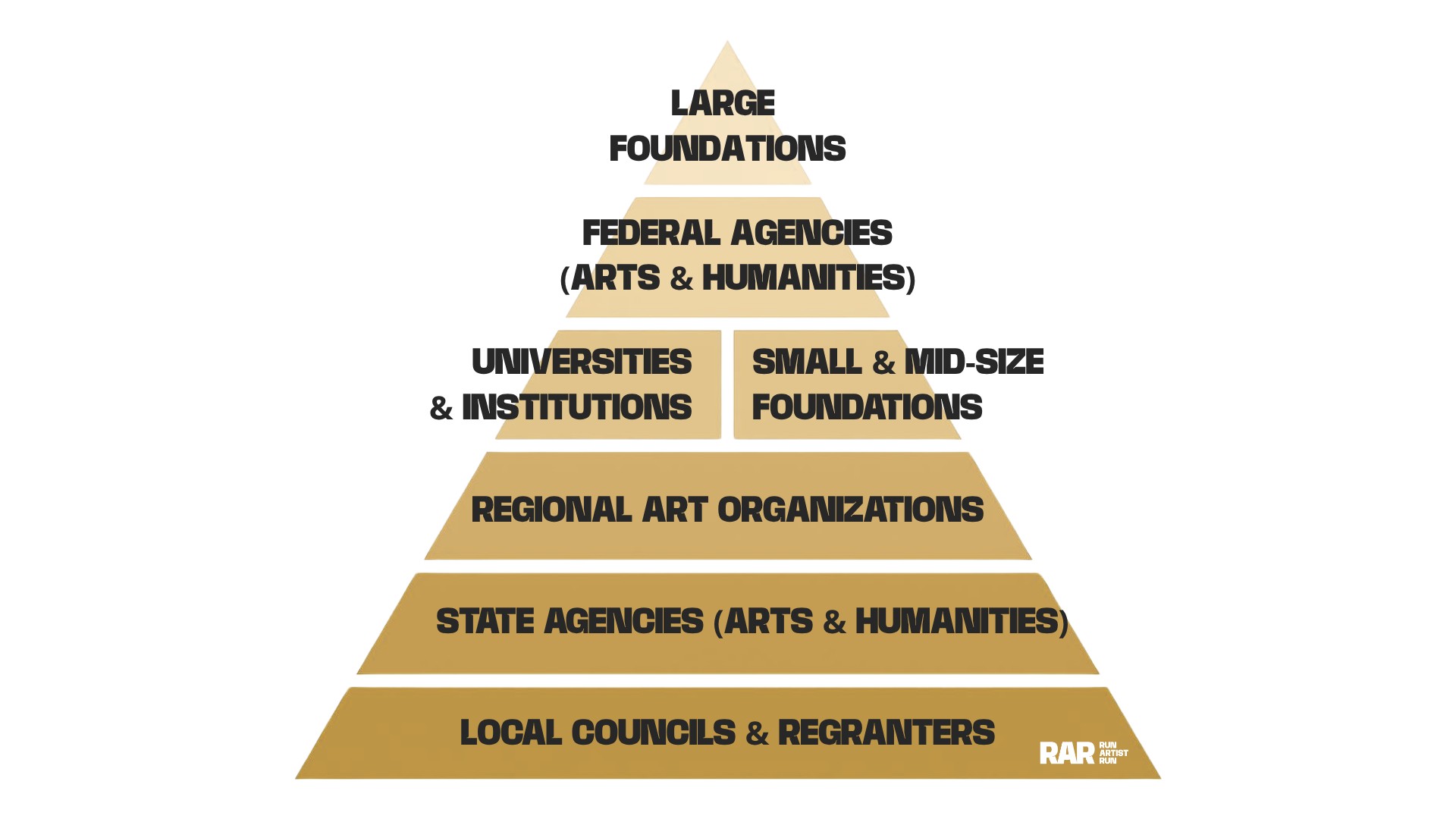
This pyramid is a map, not a mandatory path. You don’t have to climb every tier in order. What’s really important to take from this outline is that each funder type funds differently, and represents a different tier of competitiveness. Before you begin funder prospecting, let’s get you clear on the different roles of each funder type. The goal here is to ground your funder prospecting in an understanding of which funders fit your current project, career, or organizational stage. Here is a breakdown of all seven categories, from bottom to top.
🌿Local Arts Councils & Regional Regranters
These are the least competitive programs available. Eligibility is geographically restricted to a specific county or borough, which shrinks the competition pool dramatically. Many run multiple cycles per year, and most are first-grant friendly — explicitly designed for or prioritizing artists with limited grant history. They are juried anonymously, meaning they are not relationship-based. Start here.
📍 State Arts Agencies (Arts & Humanities Councils)
The first major institutional funding tier. The competition pool is wider — statewide rather than local — but the grants are larger and the credibility signal is stronger. State councils administer both direct and regranting programs across multiple eligibility categories. Fiscal sponsorship or 501c3 status is typically required at this level.
🗺️ Regional Arts Organizations
Multi-state organizations serve specific geographic regions — Mid-Atlantic Arts, South Arts, and Creative West are a few examples. They are the core funders for regional touring, presenting, and professional development. Their programs primarily serve organizations, but most include at least a few pathways for individual artists and fiscally sponsored projects.
🏢 Small & Mid-Size Foundations
More relevant for 501c3s and fiscally sponsored projects, foundations vary enormously in focus: discipline-specific, identity-focused, geographically oriented, issue-driven. A few have open calls, but most require letters of intent (LOIs), existing relationships, or nominations to access funding. This is where the long game of networking and relationship building matters.
🏫 Universities & Public Institutions
More relevant for individual mid-career artists seeking fellowships, funded residencies, and institutional commissions. These programs are less about funding a specific project and more about investing in an artist’s career potential — welcoming them into the institution’s network, community, and visibility. Incredible opportunities when the alignment is right.
🇺🇸 Federal Agencies (NEA & NEH)
These agencies offer the largest grants in the public arts sector. Eligibility typically requires organizational infrastructure — established 501c3 status, demonstrated budget scale, multi-year track records. Fiscal sponsorship is mostly non-qualifying. Applications are more competitive when they relate to the agency's thematic priorities at the time of application.
🏆 Large National/International Foundations
The apex of the pyramid for a reason — large foundations offer the largest and most sustaining grants in the private arts sector, often through multi-year relationships. Highly competitive, deeply relationship-dependent, and often effectively closed to artists and organizations who haven’t built notoriety at the lower tiers first. Watch for their open calls. Attend their public events. Build towards them — but don’t build a strategy around them.
By maintaining an intentionally diverse funding strategy, we operate from a higher plane — knowing which programs we can rely on, which require us to leverage rejections into relationships over time, and which are outright aspirational but place our work in front of influential parties.
Now that we know the funder types, let's get clear on the types of programs they run.
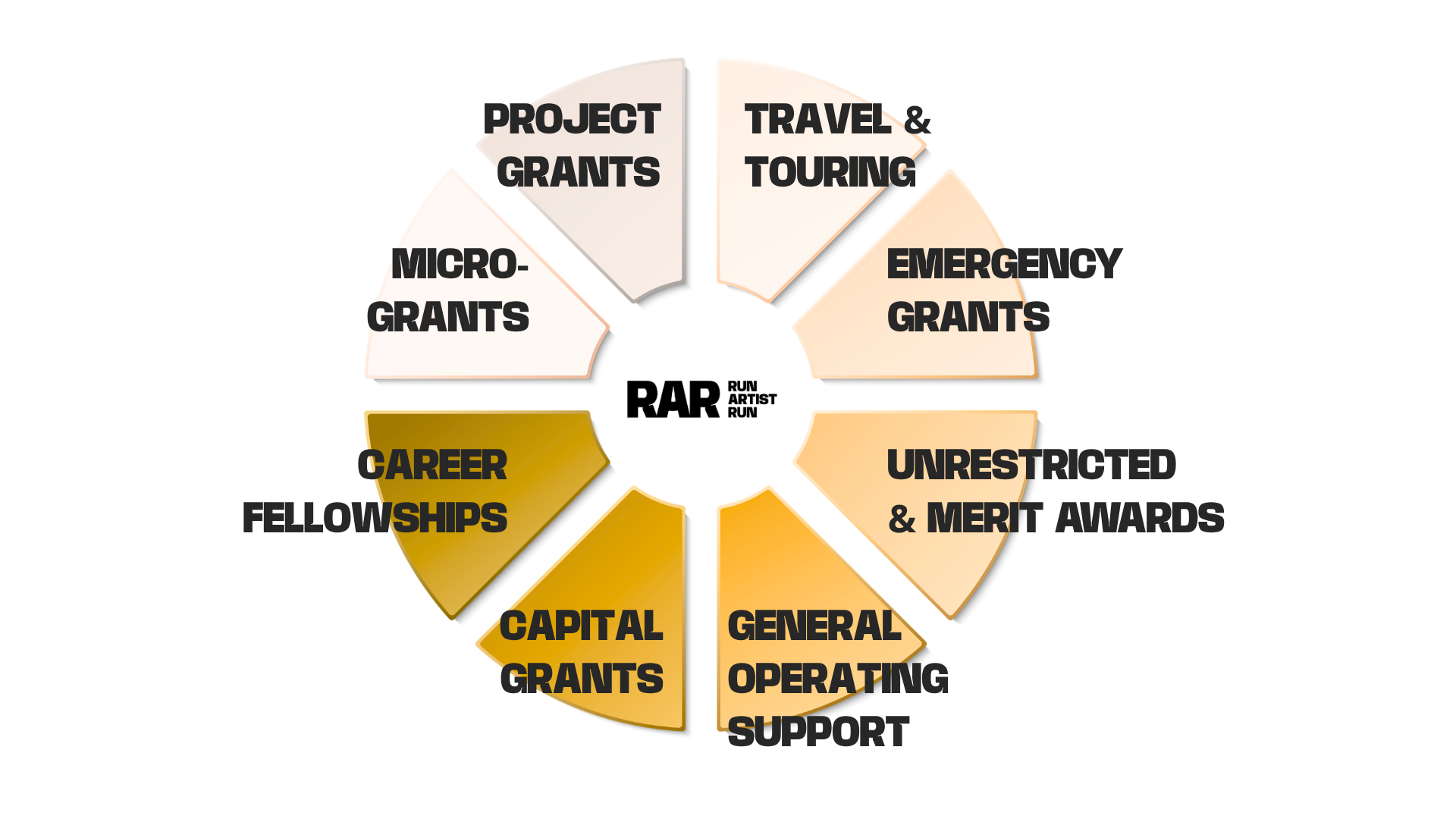
There’s a grant category for every specific funding gap. A project grant solves a different problem than a fellowship. An emergency grant solves a different problem than a capital grant. Strategic funding means matching your need to the right tool. Here is the breakdown of the eight categories, from common to complex.
🔍 Micro-Grants offer small dollar amounts, simplified applications, and quicker turnarounds. They function as entry points into the funding ecosystem. Don’t overlook them.
🦺 Project Grants are the workhorse of the ecosystem — the most common grant type, especially for individual artists. They fund a specific body of work, event, or initiative with a defined start and end date. Every funder type offers them.
🚨 Emergency Grants support artists or organizations facing unexpected financial hardship: medical emergencies, housing crisis, studio fires, natural disasters, sudden income loss. Rapid application and decision timelines, often on a rolling basis. Primarily offered by small and mid-size foundations. Know where they are before you need them.
🛞 Travel & Touring Grants are most relevant when work is moving, less when it's being made. They fund expenses related to presenting, exhibiting, or sharing existing work across state or international lines. Competitive applications showcase confirmed invitations or venue partnerships. Apply when the opportunity becomes real.
🧮 Unrestricted & Merit Awards are career-based recognition — flexible funds tied to the merit of your practice rather than a specific project. Sometimes framed as fellowships, but unlike fellowships, they carry no contractual engagement or institutional partnership. A signal that the field is paying attention.
🧑🎨 Career Fellowships fund the artist, not the project. They live somewhere between a merit award and a residency — structured like a contractual position within an institution, often requiring engagement through speaking, teaching, researching, or exhibiting. Applications are evaluated significantly on the merits of the artist, not just the proposed work.
💰 General Operating Support (GOS) primarily serves organizations with multi-year programming and a clear, ongoing impact aligned with the funder’s mission. It provides flexible support across organizational needs — staff, administration, property, program continuity. Think of it as a relationship grant: a funder acknowledging and investing in your organization at large, not just a single project.
🪙 Capital Grants fund long-term physical or infrastructural investments: building renovation, equipment purchases, tech upgrades, accessibility improvements. Reserved for established organizations with demonstrated operational capacity and public-facing facilities. Often require match funds.
By harnessing a clearer understanding of these categories, you avoid applying to grants that don’t match who you are and what you’re making. Without that alignment, the creative concept and the writing can be excellent, but your application is still likely to be set aside. The closest thing to the secret of successful grant writing is ensuring this alignment — where the funder, program type, and your project or organization all point to the same intentions.
What are the next steps?
As you prepare to research relevant funders using existing tools like Fractured Atlas’s fantastic Artist Opportunities Database or Run Artist Run’s Programs That Matter, you can now approach this process with an understanding of the types of funders most relevant to you and the types of programs that solve the particular funding gap you’re faced with.
Build your grant strategy by starting at the base of the funder pyramid. Make sure your strategy includes your local arts council, state arts commission, and the multi-state arts organization serving your region. From there, get more aspirational — find aligned programs from local, regional, and/or national small and mid-size foundations, and find out if your local universities and public institutions offer any funded programs for artists. Look aspirationally towards the open calls made available by the federal agencies and the nation’s largest arts foundations, and include a few in your strategy for the long game.
Play each funder differently. Understand the different degrees of competition the higher you go on the funder pyramid. And build yourself a diverse grant strategy that you can lean into, revise regularly, and repeat annually.
Dear artists — remember this: funder prospecting is less about where to look, and more about knowing what you’re looking for. Take the time to understand the ecosystem, and then run, artist, run.
.svg)